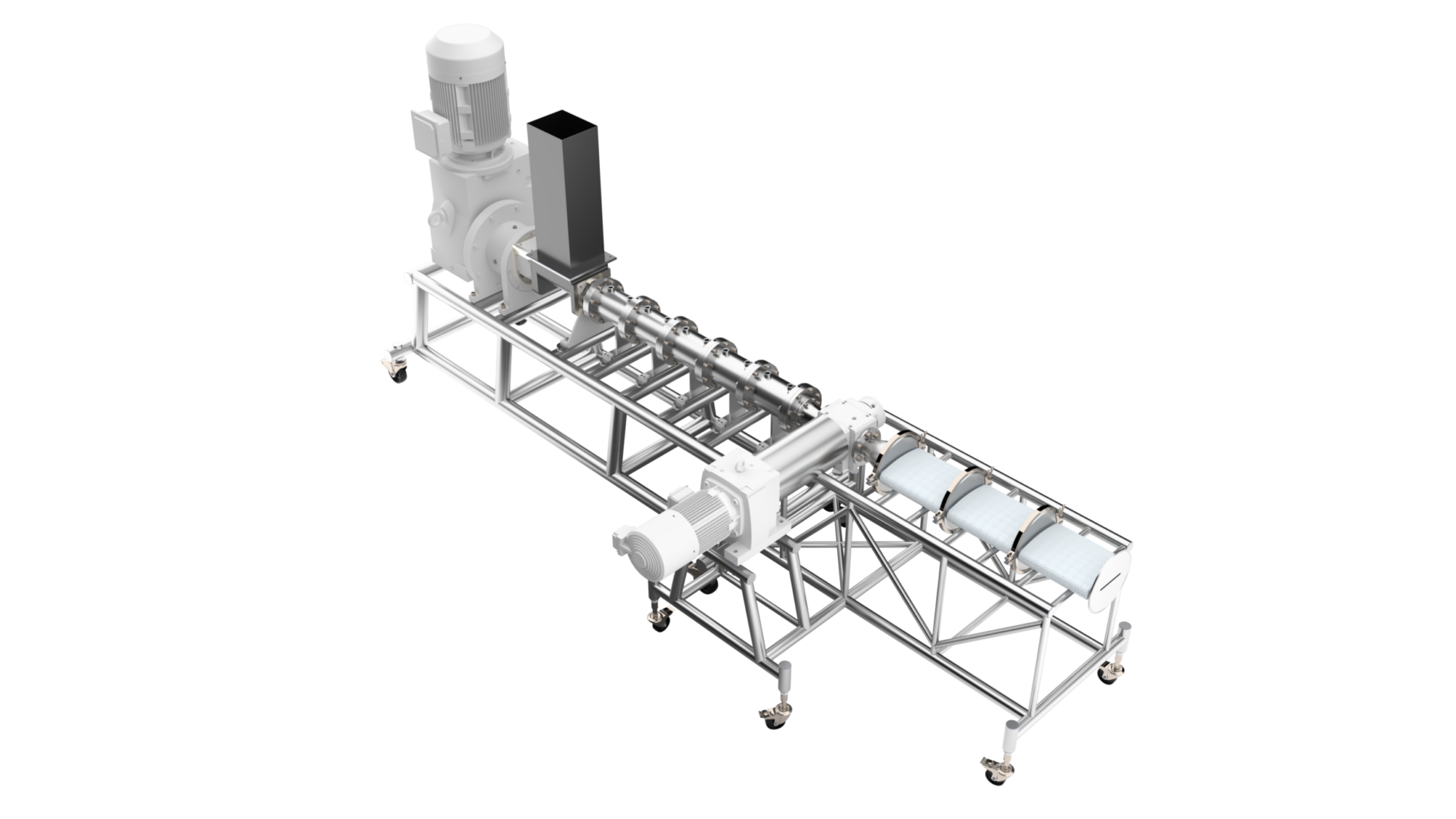
Meat Analogue Extruder
The Bonnot Meat Analogue Extruder is a single-screw system for medium- to high-moisture meat analogue (HMMA) production — plant-based and hybrid poultry, beef, pork, and seafood products. It replaces twin-screw systems at lower capital and operating cost, and integrates into existing meat and poultry lines. Developed with Ortiz Process Technologies LLC.
Why Single Screw Instead of Twin Screw?
Most HMMA production today relies on twin-screw extruders. The Bonnot single-screw approach is built to deliver comparable product results at a fraction of the capital and operating cost.
A twin-screw extruder system can cost roughly 4× the price of a single-screw extruder cooker. Beyond the purchase price, the single-screw system simplifies controls — one inlet and one outlet per cooling section — and can run on steam rather than the electrical energy that twin-screw systems typically require, which lowers energy cost in most regions where gas is cheaper than electricity. Because the SSE-and-pump combination can use existing cooling die assemblies, processors can free up their twin-screw capacity for other products rather than dedicating it to analogue runs.
The single-screw design also opens up formulation flexibility that some existing processes can’t accommodate, making it suitable for blended plant-and-animal protein and lipid systems as well as fully plant-based products.
The system has been validated in R&D testing with soy concentrate and wheat gluten formulations, achieving good fibrous texture at total liquid content up to 67% and oil addition up to 7%.

PRODUCT INFORMATION
The Bonnot Meat Analogue Extruder produces high-moisture meat analogue (HMMA) — fibrous, layered protein products that mimic the texture of whole-muscle meat. The system uses a single-screw extruder (SSE) paired with a metering pump and a cooling die assembly. A hollow compression screw running a long L:D ratio induces mechanical shear through the formulation, while multiple jacketed barrels provide zoned temperature management. The result is a continuous process that can be run in place of a traditional batch operation.
How It Fits Into a Processing Line
The extruder is designed to be synergistic with existing meat, poultry, cannery, or vegan facilities rather than requiring a purpose-built plant. No need to transport intermediate frozen product from plant to plant. Upstream, formulations must be pre-mixed before extrusion. Depending on the recipe, suitable mixers include slide-gate paddle mixers, slide-gate ribbon mixers, sigma blade mixers, or double-auger meat mixers. High-liquid or highly-soluble-solid formulations tend toward a dough-like consistency, while non-soluble and lower-liquid formulations produce a crumbly, flowable mixture. Downstream, the extruded sheet can feed into standard protein-processing equipment: pricking conveyors (to penetrate the sheet for easier marination), vacuum tumblers or brine injectors, sear markers or continuous grilling lines, cutting systems, ovens for cooking or steaming, breading and par-frying lines, and IQF or refrigeration freezing.
Applications
The primary application is meat analogue production — plant-based and hybrid poultry, beef, pork, and seafood. The same single-screw platform also serves a broad range of other industries: bulk moulding compound, carbon, chemical catalyst, clay, cold forming, fire log, food forming, hydrocolloid, pet food and treats, rodenticide, rubber, and sealants.
The Sustainability Case
For processors evaluating analogue production on environmental grounds, plant proteins require less energy to produce, process, and transport than animal protein, and the production figures are substantial. Livestock production accounts for an estimated 18% of global greenhouse gas emissions — more than transportation. By comparison, published figures for a chicken analogue indicate 75–90% less water use and a 77–87% carbon reduction versus conventional chicken, with even larger differences for beef analogue versus beef. These reductions, combined with growing global protein demand, are central to the commercial case for HMMA capacity.
The Meat Analogue Extruder is offered in three series spanning pilot-scale through high-volume production.
Available Sizes and Specifications
CO 2.25 Series
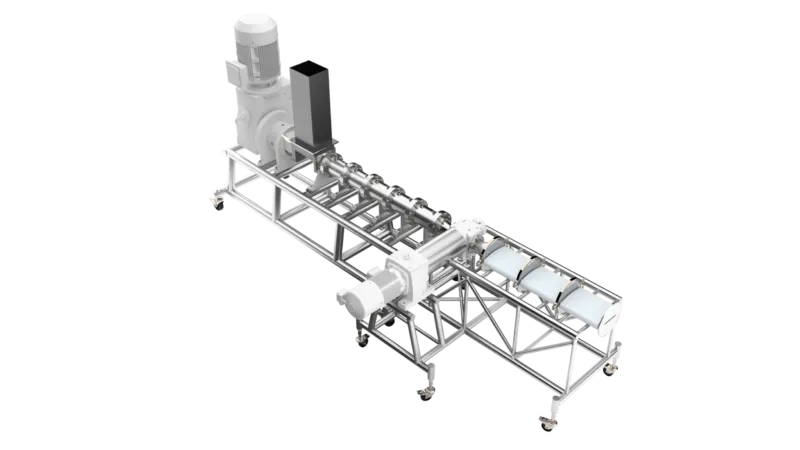
- Extruder output (lbs/hr)
- 30–70
- Approximate layout (L × H × W, in)
- 110 × 60 × 70
- Hopper opening (in)
- 6 × 5
- Extruder motor power (HP)
- 3/10
- Metering pump capacity (cc/rev)
- 20
- Metering pump output (lb/hr)
- 26 – 70
- Metering pump motor power (HP)
- 3
FREE FEASIBILITY TESTING
WANT TO PROVE IT OUT?
The Bonnot test facility offers free feasibility trials across the full CO series — different frame sizes, fiber formation profiles, and full material testing.
-
VIEW SPECIFICATION RANGES
EARLY RESEARCH
EXPLORE THE CO SERIES
Not sure which size fits your throughput target? We'll help you match your formulation to the right configuration
-
SCHEDULE A CONSULTATION
TECHNICAL EVALUATION
BOOK A TECHNICAL CONSULTATION
Discuss moisture content, fiber formation, and scale-up directly with a Bonnot process engineer.
-
READY TO TRIAL
BOOK A FREE TRIAL RUN
Bring your formulation to our facility. We'll run a trial, measure key parameters, and send you samples.